Smart Glasses Are Eroding the Meaning of Consent
A recording light is not consent. The co-founder of Stop Smart Glasses argues that camera-equipped glasses fail every test of what consent means, and that women and girls are paying the price.
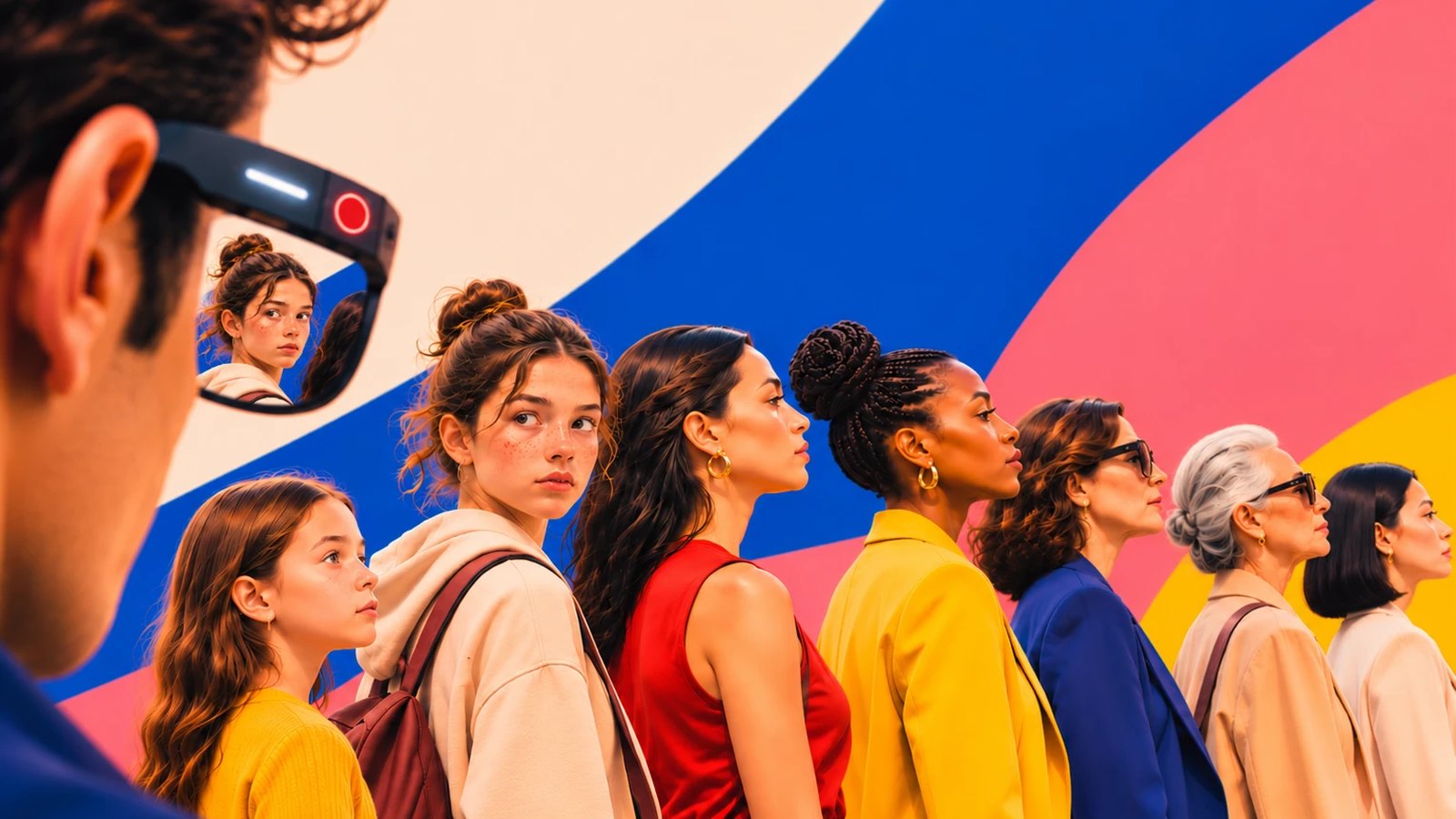
Last December, Beth Knight was 17 when a man approached her at Waterloo underground station. She told Channel 4 News he said she was attractive and asked for her Instagram. She replied that she had a boyfriend. He kept going anyway, and in the end she gave him her Instagram handle because she was scared and just wanted him to go away.
Something felt off, so afterwards she searched online and found he was filming young women around train stations and posting the videos. She waited anxiously for hers to appear. On Christmas Day it did, on a TikTok account with around 100,000 followers, twisted into an edited advert for his online dating course.
Her face was filmed and used to peddle his misogynistic products. She became his content, his product and his profit. Nobody asked her, and she had no idea his glasses were filming.
We started the Stop Smart Glasses campaign because of all the women and girls who could become a victim like Beth to this kind of harassment - or worse. I felt her story as a woman and as a mother. As a parent myself, I’m appalled that a stranger can record my child without either of us knowing.
On top of that, the footage can be shared by the wearer with Meta AI, also without anyone’s consent. This content may be used by Meta to train its AI models, and content that AI models train on is meant to have people’s knowledge and consent. This is why Meta may be in breach of GDPR.
This content is viewed by third-party contractors around the world, like the whistleblowers at Sama, Meta’s subcontractor in Nairobi, who told Swedish newspapers they had reviewed footage of people undressing and using the toilet, and that they believed those people didn’t know they were being filmed.
Kenya’s data protection commissioner opened an investigation, and a US class action now covers bystanders who never wore the glasses (which Meta has said it will fight. So expect its greasy chequebook to come out again.)
This is an outrage. It has to stop.
A Transfer of Power Dressed Up as Progress
AI-enabled, camera-equipped glasses allow people to film those around them without holding up a phone or conventional camera. For everyone around the wearer, that makes it harder to know whether they are being recorded. Because they’re designed to blend in, they can all too easily become covert surveillance devices.
It is our belief that smart glasses are eroding the meaning of what consent means. Not only is consent violated by these devices, the very language around their use attempts to change the meaning of the term ‘consent’. A light within the frames does not denote consent and the very idea makes a mockery of the painstaking work being done to ensure that consent is understood by all in society.
The broadcasting of this message by Big Tech corporations, via multi-million pound advertising campaigns, is profoundly damaging. Smart glasses fail every test that we would normally apply to what consent really means.
We Live in a World Where Women Are Already at Risk. Now Add Smart Glasses.
Police in England and Wales recorded 209,079 sexual offences in the year ending March 2025, up 11% on the year before. Over half of that rise came from two new image-based offences created under the Online Safety Act 2023, so it reflects new laws as well as new behaviour. Image-based abuse is now a crime in its own right, and that is the world these devices are entering.
In September, the UK government set up a National Taskforce for Tackling Misogyny. Yet glasses that have been used to film women and girls without their knowledge stay on the high street. We find that hard to square, and it feels like a worrying lack of joined-up thinking by the people we rely on to protect us.
Consent: The FRIES Test
Consent is often explained in society and taught in schools by using the acronym FRIES, which stands for: Freely given, Reversible, Informed, Enthusiastic and Specific. It was written for sexual consent. Smart glasses fail each and every one.
- Freely given. Meta’s guidance asks wearers to stop recording if someone objects, so the person being filmed has to notice the camera first and then speak up. This is not “freely given”, it is taken. It also, subtly but devastatingly, switches responsibility from the person doing the recording to the person being recorded. It is they who must notice, who must speak up, who must challenge - essentially, to engage in a confrontation (which could turn violent) with a complete stranger. It is deeply irresponsible of a global company to ask this of women (or anyone).
- Reversible. Once footage is posted, consent can’t be taken back. A London woman, Kate, told the BBC she was filmed in secret and trolled online. Another London woman, “Alice”, saw her clip viewed about 40,000 times, and the Metropolitan Police said they couldn’t progress the case with the limited information they had.
- Informed. The LED is meant to be the warning, but Hamburg’s data protection commissioner found it hard to notice in many settings and easy to defeat. On the newer model it actually stays dark when the wearer asks Meta AI about their surroundings.
- Enthusiastic. Nobody walking around going out about their day has said yes to being filmed or their image shared with Meta AI. Beth Knight said she was terrified during her encounter.
- Specific. The person being recorded has no idea of the purposes of the recording. For example, agreeing to be recorded does not mean you have agreed to have your content used to train Meta’s AI. The subject of the filming has no knowledge where their content could be going, from an innocent video that someone wishes to show their child later, to being livestreamed on social media, to appearing on a nudification app. Without specificity, consent is meaningless.
What Regulators Have Said, and What They Haven’t
Regulators’ views aren’t court rulings, and the EDPB statement of 13 October is preliminary and non-binding. It says private use is likely covered by the household exemption, so a wearer filming a family day out is probably not the issue.
The makers and AI providers are not exempt, and they can’t rely on the wearer to meet their own duties. The EDPB says bystander consent would be difficult to obtain and AI training particularly hard to justify.
Hamburg’s report adds that a wearer who sends footage of others to Meta AI can become “a joint controller with Meta”, which needs a formal agreement. Meta offers none. It says its third party contractors review only content users share with Meta AI, and that it filters data. The wearers themselves probably have no idea they are likely to be “non-compliant joint controllers” with Meta. What an absolute mess.
Where the Law Falls Short
Filming people in public is generally lawful in the UK, and so is posting the footage. The government points to existing offences.
However, on 4 November 2026, the safeguarding minister Satvir Kaur told MPs “the government is already looking into options to restrict smart glasses in certain settings and restricting the sale to certain users”. That is movement, but it doesn’t protect the person who is filmed. It doesn’t address the fact that Meta AI is training its models using footage of people who never gave their consent.
Covertly recording someone in public or posting that footage online needs to become a specific criminal offence. It would need to protect journalism and ordinary photography, but it is clearly urgently needed, for mobiles as well as smart glasses. Liberal Democrat MP Wera Hobhouse has tabled a bill to create offences for non-consensual recording and distribution of images, and we support it.
What We Are Asking For
We support smart glasses as assistive technology for blind and partially sighted people. An exemption can be written, with identifiable devices and disabled people’s input.
To allow this to happen, we urgently require a pause on all mass-market sales, while Parliament debates. We also demand that they be barred from a variety of specific locations, including schools, public transport, parks, leisure centres, swimming pools, doctor’s surgeries and more, and for an urgent cross-party review involving key stakeholders.
Meta Cannot Be Trusted. So Why Are We Trusting Them?
Meta has spent most of 2026 in court, either being found liable or settling claims and paying huge sums of money for allegedly knowingly designing addictive algorithms that harmed children.
Its reputation is in tatters. Zuckerberg and his company should be labelled a pariah - and yet that’s not what’s happened. Meta stock prices increased after the settlement and Zuck was soon back on stage delivering keynotes on either his smart glasses, or his new AI model, Muse Spark - both data-scraping devices on a level not seen before.
People are all too willing to just shrug it off and accept Meta’s place as a mainstream Big Tech giant. Too many of us have accepted that smart glasses are inevitable, or like the next step in mankind’s technological evolution.
But products are not inevitable, they are choices. We believe smart glasses are actually the opposite of technological evolution. Because they are so damaging, they represent a step back for mankind and society as a whole.
I write this as a mother to a young son, and I fear for the behaviour he will see around him, and for how it could shape him. He’s only human, and so are we all. Human, flawed, and capable of doing the wrong thing.
I’m not a psychologist, but it’s important to understand teen brain function here. The prefrontal cortex, behind the forehead, handles impulse control and weighing consequences. It’s among the last parts of the brain to mature, and it keeps developing into the mid-to-late 20s.
Emotion and reward systems develop earlier and run strong in the teenage years, while the brakes are still being wired up, as peer-reviewed research shows. That’s why a teenager aged 13 to 16 can know the rule and still do the thing, especially with peers watching.
It is precisely the worst moment in life to hand teenagers such a device. In US schools, a Futurism review found videos of teenage boys using Meta glasses to film and harass girls, often without their knowledge, then posting the clips to humiliate them further.
Meta says the LED can’t be switched off and covering it disables the camera, but Futurism reports it can be modified or blocked with a sticker, as Hamburg’s regulator also found.
Beyond the Recording: The Human Cost
It pains me to write this, but how long until a child takes their own life due to the humiliation of being filmed by someone in smart glasses and the content posted online?
We have to fight tooth and nail on this. We have to stand up for women and children, and for the generations who come after them, and say not on our watch.
The EDPB warns that if anyone nearby could be filming, people alter their behaviour and suppress spontaneity. Everyday trust begins with strangers. We don’t want a society that lives under surveillance, with suspicion laced through every public outing.
Women in this country fought hard for equal rights and the freedom to move through public life without being watched, and we should be defending it. If smart glasses keep eroding it, we fear the trust goes with it. Girls deserve better. So do boys.
We have a window to reject Meta’s dystopian future, but it is shrinking fast. I ask you all to stand with us.
Sign our petition and tell the UK government and use our template letters to tell national retailers we don’t need them, we don’t want them, we do not consent to this.
References
- Channel 4 News. Video report on Beth Knight and smart glasses. youtube.com
- PetaPixel (2026). Disturbing report says workers are watching private footage taken on Meta smart glasses. petapixel.com
- Malay Mail (2026). I spy with my Ray-Bans: Kenya eyes Meta glasses over alleged data snooping. malaymail.com
- Office for National Statistics. Sexual offences prevalence and trends, England and Wales: year ending March 2025. ons.gov.uk
- UK Parliament (2026). Written statement HLWS371. parliament.uk
- Planned Parenthood. Sexual consent. plannedparenthood.org
- Meta. AI glasses privacy. meta.com
- BBC News (2026). I was secretly filmed with smart glasses and then trolled online. bbc.co.uk
- BBC News (2026). Man in smart glasses filmed me in London then told me to pay. bbc.co.uk
- Hamburg Commissioner for Data Protection and Freedom of Information (2026). Final report on Ray-Ban Meta AI Glasses. datenschutz-hamburg.de
- European Data Protection Board (2026). Statement on smart glasses, 13 October. edpb.europa.eu
- The Guardian (2026). UK government considers smart glasses ban over secret filming concerns. theguardian.com
- UK Parliament. Images (Non-consensual Recording and Distribution) Bill. bills.parliament.uk
- CNBC (2026). Meta must pay $375 million for violating New Mexico law in child exploitation case, jury rules. cnbc.com
- ABC News (2026). Meta settles with states in landmark social media addiction case. abcnews.com
- National Institute of Mental Health. The teen brain: 7 things to know. nimh.nih.gov
- The Adolescent Brain. PubMed Central. pmc.ncbi.nlm.nih.gov
- Futurism (2026). Teen boys are using Meta glasses to harass and bully girls at high schools and middle schools. futurism.com
- Stop Smart Glasses. Campaign email templates. stopsmartglasses.com
The AI Daily Five