When Everyone Can Create Content, What Makes a Company Worth Listening To?
AI can produce polished corporate content in seconds. But when everyone has access to the same tools, independent thinking and a distinctive point of view may become a company's greatest advantage.
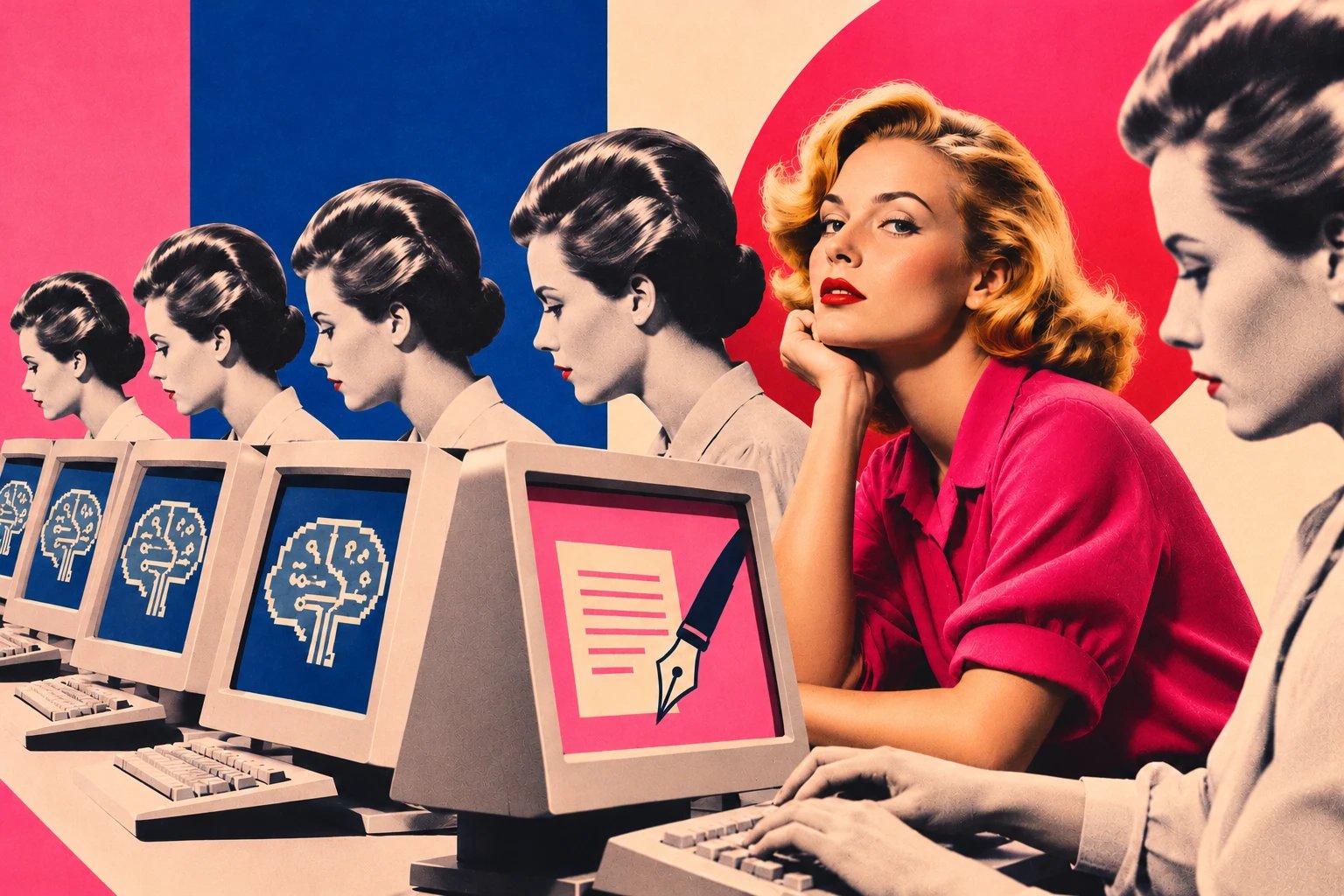
Scroll through your feed for a minute. Press releases, thought-leadership posts, brand statements: the grammar is flawless, the structure is persuasive and the tone is calibrated for the audience. And most of it is forgotten before the next swipe.
We are already in an era in which producing content is no longer the difficult part. A few prompts can generate a press release, a campaign concept or a LinkedIn post in seconds. If everyone uses similar tools, trained to produce plausible answers, what will set one company’s communication apart from another’s?
Until now, the debate about AI in communication has focused on productivity: time saved, assets produced, messages scaled. Those are legitimate questions, but they are not the most important ones. The more fundamental question is what happens to critical thinking, originality and creativity when producing an answer becomes easier than questioning it.
Communication has never been just about finding the right words. It has always been about having something meaningful to say, knowing why it matters and understanding why anyone should listen. In an age of automated content, the scarce resource is no longer the ability to produce words. It is the ability to think independently, develop an original point of view and express it in a voice that reflects who we really are.
AI can help us write, but it must never do our thinking for us. However, I fear that is already happening.
If we lose that independence, we lose the foundations of any marketing strategy: differentiation, positioning and a compelling reason for people to choose us over someone else.
Authenticity: Sounding Right Is Not the Same as Being Different
Polished messages, a professional tone and compelling narratives used to signal quality. Now anyone can produce them, so they no longer differentiate a brand.
Try a simple test. Take your latest corporate post, remove the logo and read it as a stranger would. Could a competitor have published it unchanged? If so, the problem is not the writing. It is that the message has no position.
Audiences also seem to care about who is behind the words. In experiments published in the Journal of Business Research, researchers Colleen Kirk and Julian Givi found that consumers responded less favourably to emotional marketing messages when they believed AI had written them. Messages that AI had only edited were penalised less.
The findings suggest that consumers respond differently when they believe AI has written a message rather than merely helped to edit it. The distinction matters for companies deciding how much of their communication to automate.
Authenticity comes from a distinctive point of view, from knowing what a company stands for and from making sure its words match its actions. AI can help articulate that identity, but it cannot define it. The challenge is not to make AI sound like our brand. It is to make sure our brand has something distinctive to say in the first place.
Critical Thinking: Are We Questioning or Just Accepting?
AI makes answers easy to find, but critical thinking starts with questioning them: challenging assumptions, exploring alternatives and being willing to reach conclusions that are not the most obvious or convenient.
The risk is that when a convincing answer is always available, we stop asking the questions that could lead somewhere unexpected. A well-written message is not necessarily a good message, and a convincing argument is not necessarily the right one. Our value also lies in judging whether an idea deserves to be communicated at all.
Research from Microsoft and Carnegie Mellon University points in the same direction. In a survey of 319 knowledge workers who used generative AI at least weekly, those who trusted the tool more reported putting less effort into critical thinking, while those who were more confident in their own skills reported putting in more.
The data is self-reported and does not establish that AI causes a decline in critical thinking. But the pattern is worth taking seriously. The findings suggest that confidence in our own judgement matters when deciding how much thinking to delegate.
The same applies to those of us who work in SEO and GEO. If everyone optimises for the same answers, companies risk repeating the same arguments, ideas and keywords. The perspectives that truly define us are the ones we have to protect, rather than simply accepting what a model suggests first.
Creativity: What Happens to the Ideas AI Doesn’t Suggest?
Creativity rarely follows a straight line. It comes from experience, contradiction, curiosity and unexpected connections. Some of the best ideas look irrelevant, impractical or even wrong at first.
If we rely too heavily on AI to generate ideas, we risk limiting ourselves to what it suggests instead of exploring what we might discover on our own.
A study in Science Advances by Anil Doshi (UCL) and Oliver Hauser (University of Exeter) illustrates the trade-off. Writers who received story ideas from AI produced work rated as more creative, especially those who had initially performed less well on creativity measures. But the AI-assisted stories were also more similar to one another than stories written without AI. Collectively, we all start to sound alike.
The experiment examined short-story writing rather than corporate communication, but its findings raise an important question for companies. Could the tools that help us produce better individual pieces of content also make our collective output less distinctive?
The ideas we leave at the back of our minds because AI did not propose them may be the ones that would have set us apart. AI can expand our creativity, but only if we bring something of our own to the process.
The Ideas Only We Can Bring
None of this is an argument against using AI. I use it, and it is useful. It is an argument about who does the thinking.
The danger is not that AI will write badly. It is that it will write well enough for us to stop asking whether we had anything different to say.
Every plausible draft we accept without questioning it is a small decision to leave our judgement unused. Multiplied across thousands of companies, those decisions risk producing the sameness we already see in our feeds.
So before the next prompt, ask a simpler question: if AI disappeared tomorrow, would we still know what we believe? And would we still be able to write something worth reading?
References
- Kirk, C. P., and Givi, J. (2025). The AI-authorship effect: Understanding authenticity, moral disgust, and consumer responses to AI-generated marketing communications. Journal of Business Research, 186, 114984. doi:10.1016/j.jbusres.2024.114984
- Lee, H. P., et al. (2025). The Impact of Generative AI on Critical Thinking: Self-Reported Reductions in Cognitive Effort and Confidence Effects From a Survey of Knowledge Workers. Proceedings of the 2025 CHI Conference on Human Factors in Computing Systems. doi:10.1145/3706598.3713778
- Doshi, A. R., and Hauser, O. P. (2024). Generative artificial intelligence enhances individual creativity but reduces the collective diversity of novel content. Science Advances, 10(28), eadn5290. doi:10.1126/sciadv.adn5290
The AI Daily Five